
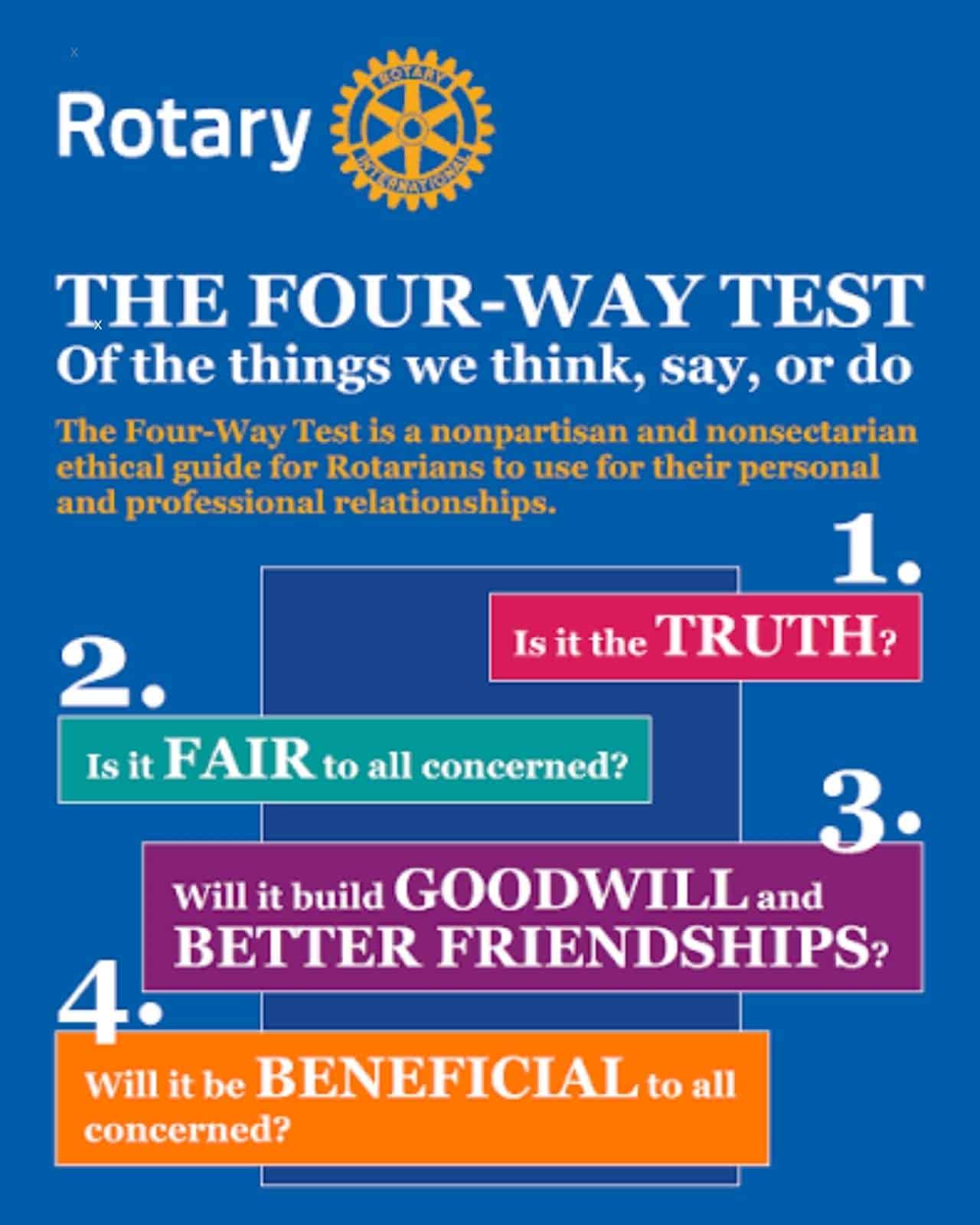
 At every Rotary meeting, we recite the Four-Way Test.
Most of us know the words by heart.
But how often do we stop to think about what they really mean?
The Four-Way Test was never intended to be something we simply memorised or repeated at the end of a meeting. It was created as a practical guide for making better decisions, whether at work, at home, while travelling, or in our communities.
In many ways, it is just as relevant today as it was nearly a century ago.
A Simple Idea Born in Difficult Times
The Four-Way Test was written in 1932 by Rotarian Herbert J. Taylor. At the time, he had been asked to rescue a company on the brink of bankruptcy during the Great Depression.
Rather than looking first for financial solutions, he believed the company needed something even more important: a shared commitment to honesty, fairness, and integrity.
He wrote four simple questions and challenged everyone in the company to use them whenever they made a decision.
The results were remarkable.
The company recovered, and the Four-Way Test eventually became one of Rotary’s best-known ethical guides. Rotary officially adopted it in 1943, and today it has been translated into more than 100 languages and is used around the world.
More Than Rotary Tradition
The Four-Way Test is just twenty-four words.
That’s all.
Yet those twenty-four words have guided generations of Rotarians in their personal lives, their businesses, and their service.
It’s easy to think of the Four-Way Test as something we say during Rotary meetings. The real challenge begins after the meeting ends.
It shows up:
- When we’re deciding how to respond to an email.
- When we’re discussing a difficult issue while traveling.
- When we’re working alongside fellow Rotarians on a service project.
- When we’re travelling and interacting with people whose culture or perspective may be different from our own.
- When we’re deciding whether to speak up, stay silent, apologise, forgive, or help.
These ordinary moments are where the Four-Way Test comes to life.
It’s Especially Relevant for Global Travelers
As members of Global Travelers, we have a unique opportunity to put these principles into practice.
Our club spans continents, cultures, languages, and time zones. We meet people with different experiences, beliefs, and ways of seeing the world. We serve in communities that may be very different from our own.
The Four-Way Test reminds us to approach those experiences with integrity, fairness, respect, and a genuine desire to build understanding.
An Invitation
Over the coming weeks, we’ll take a closer look at each of the four questions, not as something to memorise but as a practical guide for everyday life.
Each article will include questions to reflect on and simple ways to practice one part of the Four-Way Test in your daily interactions.
You might be surprised how often these four questions apply, and how much difference they can make.
Until then, here’s one question to leave you with:
The next time you’re about to say something, write something, or make a decision, what might change if you paused for just a few seconds and quietly asked yourself…
“Does this pass the Four-Way Test?”